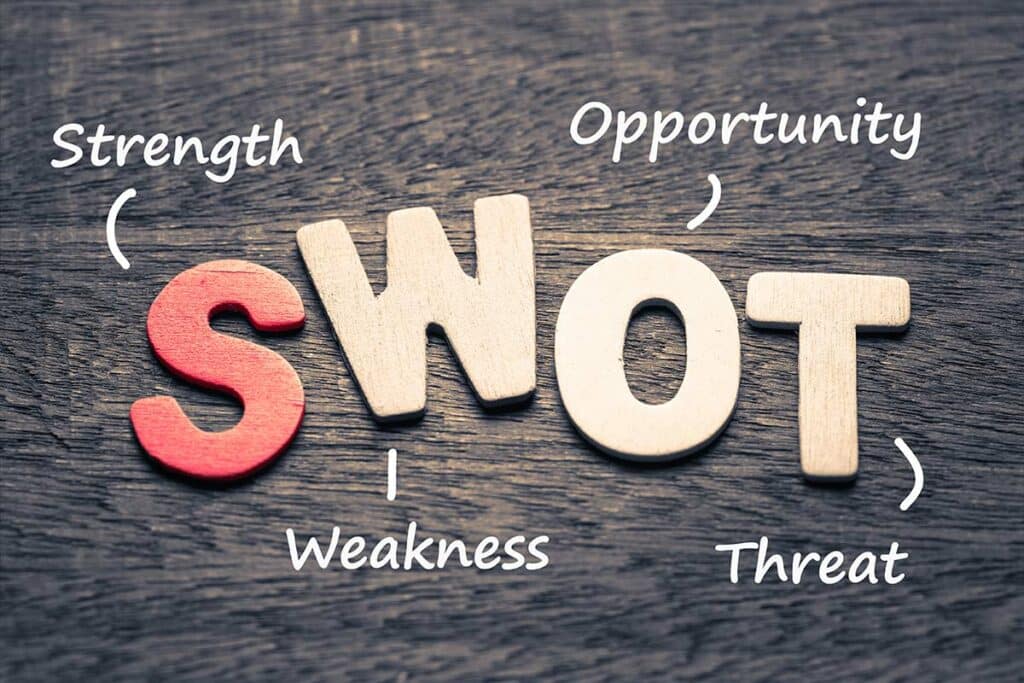
In business, success depends on the ability to adapt, innovate and make informed decisions. One invaluable tool that aids in achieving these goals is a SWOT analysis which is a structured approach used to assess the current state of a business and charting a course for the future.
SWOT analysis is often one of the first steps in the strategic planning process. It provides a comprehensive view of the business by categorizing its internal attributes as strengths and weaknesses and external factors as opportunities and threats. By identifying these key elements, leaders can develop strategies that build on their strengths, address weaknesses, seize opportunities and defend against threats. This structured approach ensures that business plans are grounded in a realistic understanding of the organization’s capabilities and its operating environment.
One of the fundamental advantages of SWOT analysis is that it helps align the organization’s internal capabilities with external market conditions. This alignment is crucial for the development of strategies that are not only ambitious but also attainable. Understanding the interplay between internal and external factors enables businesses to set goals that are in harmony with the realities of the market. It prevents the creation of strategies that are disconnected from the business’s strengths and weaknesses or are unrealistic given the current opportunities and threats.
Every business faces risks, and some of these risks can be anticipated through SWOT analysis. By identifying potential threats in advance, a company can prepare contingency plans to mitigate their impact. This proactive approach to risk management reduces the likelihood of unforeseen challenges catching a business off guard, enabling it to respond more effectively when adverse conditions arise.
SWOT analysis provides a structured and systematic evaluation of the factors affecting a business. This structured approach guides decision-makers, ensuring that choices are informed and evidence-based. Rather than relying on gut feeling or intuition, business leaders can use SWOT analysis to make decisions with a greater degree of confidence. It offers a roadmap for strategic choices that are backed by a comprehensive understanding of the business’s situation.
Efficient resource allocation is a cornerstone of successful business strategy. SWOT analysis plays a vital role in this regard by helping companies direct their time, money, and personnel toward areas that have the greatest potential for success. It allows businesses to prioritize investments in line with their strengths and opportunities, avoiding unnecessary spending in areas of weakness and low potential.
SWOT analysis is not a one-time exercise. It is an ongoing process that must be revisited regularly to adapt to changing circumstances. In a dynamic business environment, strengths can become weaknesses, opportunities can shift, and new threats can emerge. By continually assessing their SWOT, businesses can fine-tune their strategies and adapt to evolving conditions. This commitment to continuous improvement ensures that the business remains agile and responsive to change.
 Nyangi Consultants LLP